You don't need a passport to see one of the great wildlife spectacles on Earth. Every year, a handful of American landscapes funnel millions of migratory birds along major flyways.
Exploring the top 10 hotspots in United States provides an unforgettable window into nature. Across these premier birding hotspots and birding locations, geography bunches massive flocks into compact viewing zones.
Arrive during the right week, and you can spot thousands of individual migratory birds from a single overlook.
Some hotspots peak in autumn as raptors ride coastal winds. Others burst with warblers in spring or shelter rare endemics you won't find anywhere else on the continent.
Key Takeaways
- Seasonality Dictates Success: Time your trip carefully, whether catching May warblers at Magee Marsh or October raptors in Cape May, New Jersey.
- Geography Creates Funnels: Peninsulas, shorelines, and desert oases bunch massive flocks into compact viewing zones.
- Weather Drives Activity: Passing storm systems and wind shifts trigger major events like Gulf Coast fallouts.
- Endemics Require Specific Travel: South Texas, Denali, and Hawaiʻi host native species found nowhere else in North America.
Cape May, New Jersey: Fall Raptors and Coastal Migrants
Cape May, New Jersey earns its title as "The Raptor Capital of North America" every autumn. Geography funnels southbound hawks, falcons, and eagles directly along the Atlantic Flyway toward the peninsula's narrow southern tip.
Many raptors and passerines embarking from Maine and eastern Canada follow the coastline south toward New Jersey. Travelers who begin their autumn birding along the rocky shores of Acadia National Park often trace this same migration path downward.
On October 4, 1977, observers counted 21,800 hawks in a single day at the Cape May Hawkwatch. That single flight still sets the standard for what can happen here.
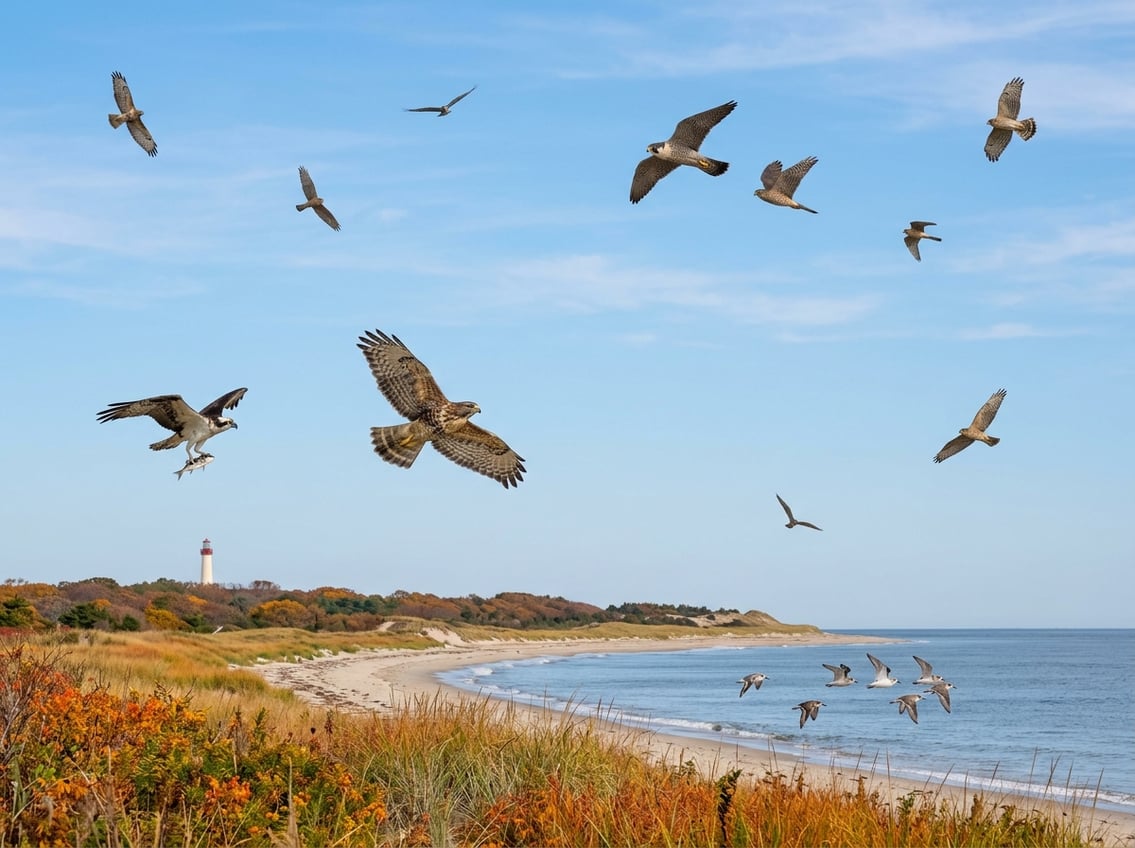
Staff and volunteer naturalists affiliated with the Cape May Bird Observatory monitor the Cape May Point State Park hawk platform daily from September 1 through November 30. The raised deck gives you clear views of passing raptors all season, creating an ideal setting for raptor watching.
Timing varies by species. According to New Jersey Audubon's Cape May Hawkwatch, about 90% of peregrine falcons push through between September 26 and October 12. Golden eagles peak during the final week of October.
Nearby, Higbee Beach Wildlife Management Area features nearly 2 miles of trails through coastal dunes, fields, and woods. The New Jersey Department of Environmental Protection notes that songbirds drop here after crossing Delaware Bay.
Visit Higbee the morning after a cold front brings northerly winds. You can also explore South Cape May Meadows nearby, which shelters shorebirds and waterfowl in a compact freshwater marsh.
3 Absolute Highlights:
- Watching thousands of migrating raptors pass the Cape May Point platform on peak autumn days
- Hiking Higbee Beach after a cold front to catch fallout warblers and thrushes
- Scanning South Cape May Meadows for mixed flocks of resting shorebirds
Check in at the Cape May Bird Observatory center for recent sightings, birding gear, and guided walks before heading into the field.
Where to Stay in Cape May
Congress Hall, an iconic beachfront resort dating to 1816, sits right in town within easy reach of both the hawk platform and Higbee Beach.
Compare local listings on Booking.com or Expedia to reserve a room well ahead of the busy fall migration.
Magee Marsh, Ohio: Spring Warblers at Eye Level
Known officially as the Magee Marsh Wildlife Area, Ohio features this celebrated refuge where you can see vibrant songbirds at point-blank range every May. Tens of thousands of northbound warblers pause along the shoreline before flying across Lake Erie.
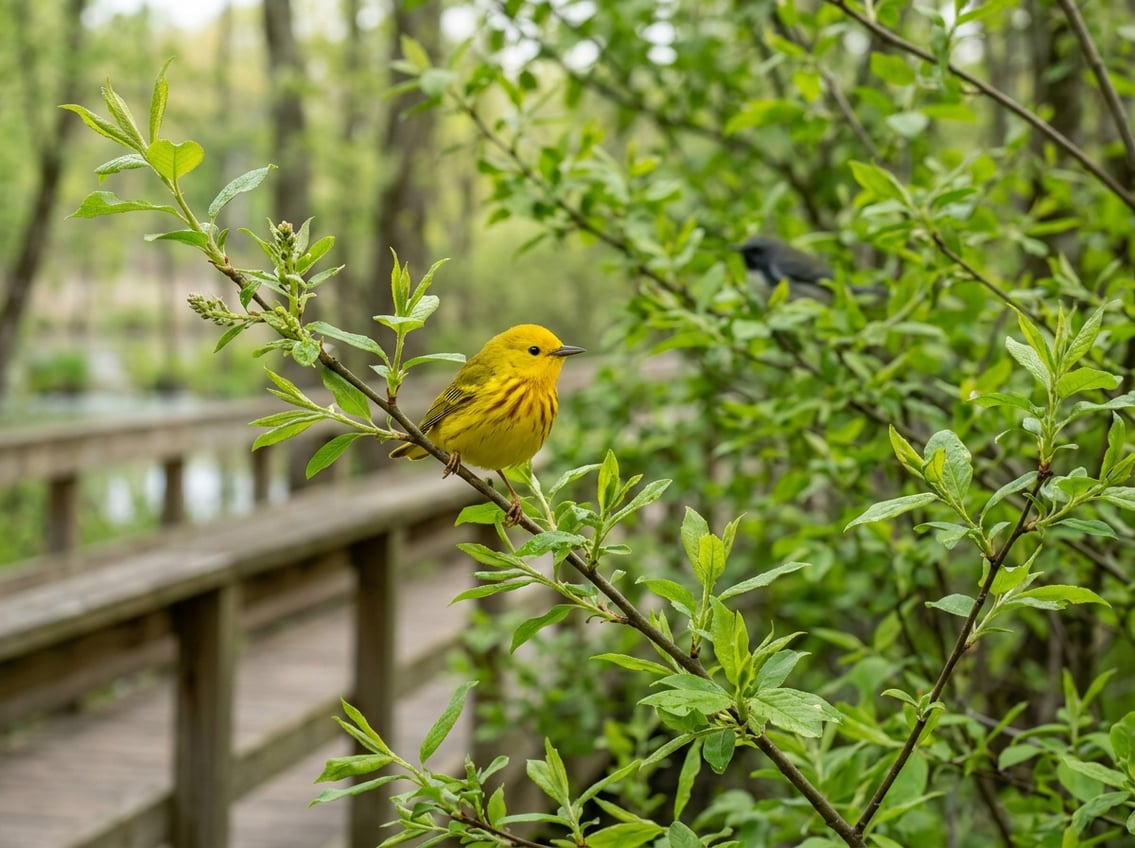
Just across the lake lies Canada's Point Pelee National Park, making this western Lake Erie basin an indispensable migratory corridor. The famous boardwalk brings these tiny migrants so close that you rarely need binoculars.
While eastern forests in Great Smoky Mountains National Park shelter dozens of nesting warbler varieties all summer, Magee Marsh concentrates huge migratory waves into a few intense weeks.
Birders have recorded over 270 species along this stretch, which anchors the Western Lake Erie Marshes Loop.
Timing is everything here. Banding data from Magee Marsh's birding resource site shows that the second and third weeks of May offer peak diversity and numbers.
Spring winds across Lake Erie can temporarily halt travel, filling the Magee Marsh Wildlife Area with exhausted migrants foraging near the ground.
Plan to spend several days on-site, since daily shifts in wind and weather alter flight patterns. Keep an eye out for golden prothonotary warblers foraging low in the swamp, and scan above for bald eagles.
3 Absolute Highlights:
- Walking the boardwalk during mid-May for close-up views of diverse wood-warblers
- Spotting a prothonotary warbler feeding low in the flooded swamp forest
- Watching bald eagles soar over the surrounding freshwater marsh
Where to Stay near Magee Marsh
Oak Harbor, Ohio sits just minutes from the marsh and offers quick access for early morning boardwalk walks.
Search Booking.com or Expedia for hotels in Oak Harbor or Port Clinton before the annual May festival fills local rooms.
High Island, Texas: Gulf Coast Migration Fallouts
High Island hosts some of the most famous migration "fallouts" in the world. Exhausted songbirds drop straight into coastal trees after an 18-hour nonstop flight across the Gulf of Mexico.
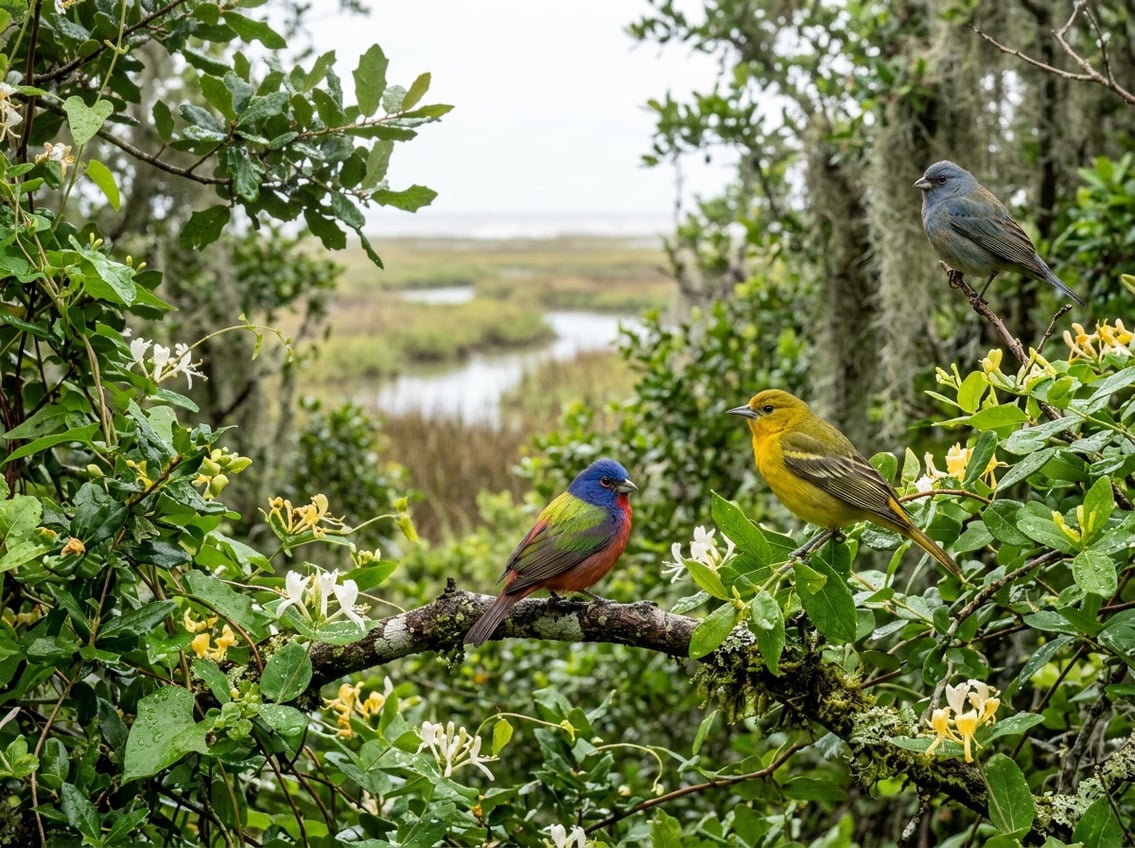
A network of sanctuaries, including Boy Scout Woods, packs huge numbers of migrants into small oak mottes. While sites like Bon Secour National Wildlife Refuge in Alabama also provide crucial rest along the Gulf, High Island offers legendary fallout density.
Slight coastal elevation makes this woodland the first refuge birds spot after open water.
Spring storms trigger these dramatic spectacles for migratory birds crossing the Gulf. When headwinds or rain downpours hit arriving flocks, warblers, orioles, and tanagers pile into branches by the dozen, lighting up entire tree canopies.
Wading bird rookeries provide another major draw nearby. From late March through May, herons, egrets, and roseate spoonbills court and build nests in plain view from raised blinds.
3 Absolute Highlights:
- Experiencing an April fallout at Boy Scout Woods after a passing coastal storm
- Viewing nesting roseate spoonbills and egrets at the nearby Smith Oaks rookery
- Covering multiple compact sanctuaries on foot in a single morning
Where to Stay near High Island
Galveston sits about 30 minutes away and offers the broadest selection of hotels, restaurants, and amenities.
Check Booking.com or Expedia to secure reservations in Galveston before the April migration peak arrives.
Bentsen-Rio Grande Valley State Park: South Texas Specialties
Bentsen-Rio Grande Valley State Park introduces birders to subtropical species found nowhere else in the United States. Mexican brushland pushes across the border here, creating a rare habitat pocket.
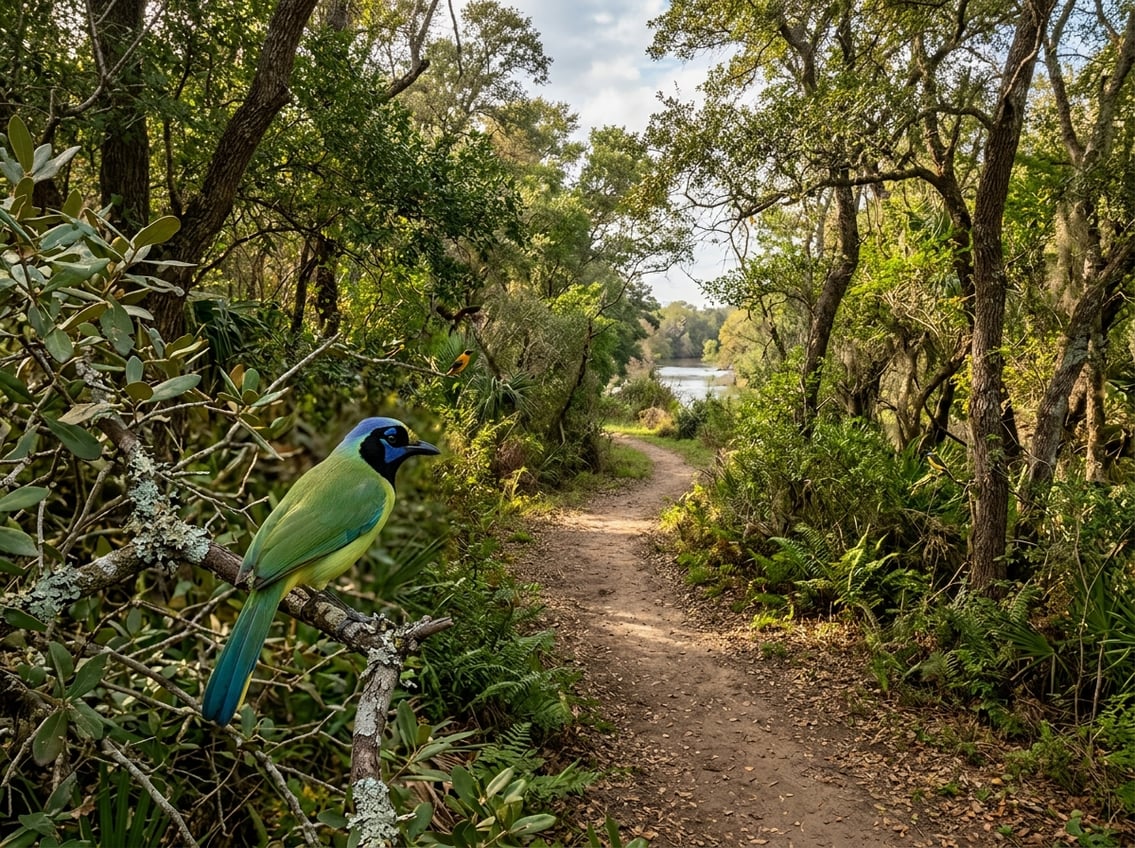
Park records list around 360 bird species, according to Texas Parks and Wildlife. Resident specialties include the Green Jay, Great Kiskadee, Plain Chachalaca, and Altamira Oriole.
While southwest canyon birders seek the rare elegant trogon, this subtropical corner offers its own unique Mexican borderland specialties.
The park prohibits private vehicles, keeping trails quiet for foot travelers, cyclists, and tram riders. A two-story hawk tower looks out across the forest canopy toward the Rio Grande and Mexico.
During spring and autumn, massive kettles of Swainson's and broad-winged hawks pass directly over the tower. Feeding stations along the trails offer reliable looks at buff-bellied hummingbirds and other regional treasures.
3 Absolute Highlights:
- Watching Green Jays and Plain Chachalacas visit feeding stations along quiet trails
- Scanning for migrating raptor kettles from the two-story hawk tower
- Searching for rare subtropical strays along the historic Rio Grande riverbed
Where to Stay in the Rio Grande Valley
Mission, Texas sits right down the road from the park gate, making it a convenient hub for early mornings.
Properties like SureStay by Best Western Mission put you within minutes of the park. Check Booking.com or Expedia for current rates during the prime October-to-April season.
Everglades National Park: Winter Wading Birds
Everglades National Park puts on its best birding show during the winter dry season. Shrinking water levels gather fish into shallow pools, drawing thousands of wading birds out into the open.
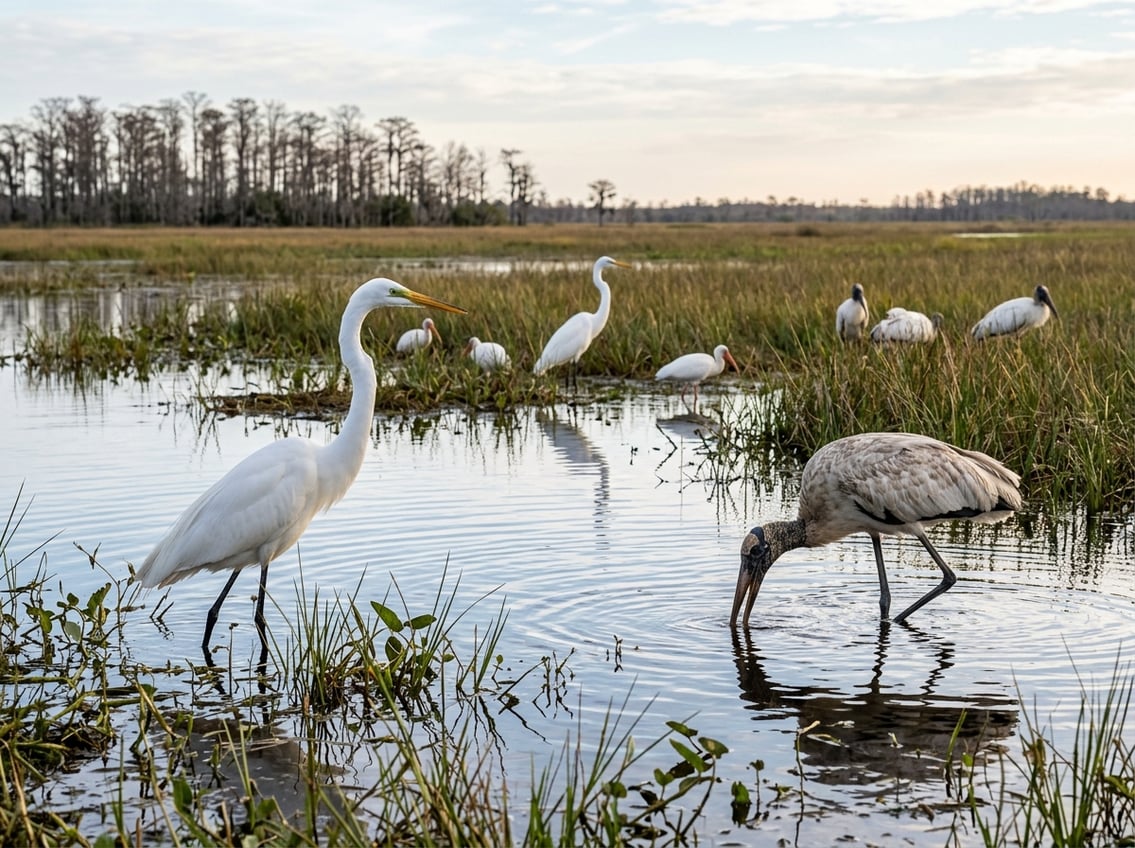
The 0.8-mile Anhinga Trail at Royal Palm offers an unmatched vantage point. According to the National Park Service, this paved and boardwalk loop ranks among the most reliable wildlife trails anywhere in the country.
From December through March, you can watch wood storks, white ibises, and great blue herons feeding mere feet away. Purple gallinules step across lily pads, while pink roseate spoonbills sift the mudflats.
Other renowned southern refuges like J.N. “Ding” Darling National Wildlife Refuge and Okefenokee National Wildlife Refuge protect teeming swamps, but the Everglades delivers close-up views on an unprecedented scale.
Barrier island havens like Jekyll Island also harbor exceptional winter flocks, yet nothing matches the vast river of grass. As noted in the National Park Service's birding guide, anhingas build nests right along the railing.
3 Absolute Highlights:
- Strolling Anhinga Trail during the winter dry season to see dense flocks of feeding waders
- Viewing roseate spoonbills and wood storks foraging in shallow canals
- Watching nesting anhingas and hunting purple gallinules right beside the boardwalk
Where to Stay near the Everglades
Homestead, Florida offers the most practical base, sitting just a short drive from the main park entrance at Royal Palm.
Check Booking.com or Expedia to find local hotels before winter crowds arrive.
Bosque del Apache, New Mexico: Cranes at Sunrise
Bosque del Apache National Wildlife Refuge hosts one of the Southwest's most stunning winter spectacles. At sunrise, tens of thousands of sandhill cranes and snow geese take flight against the Chupadera Mountains.
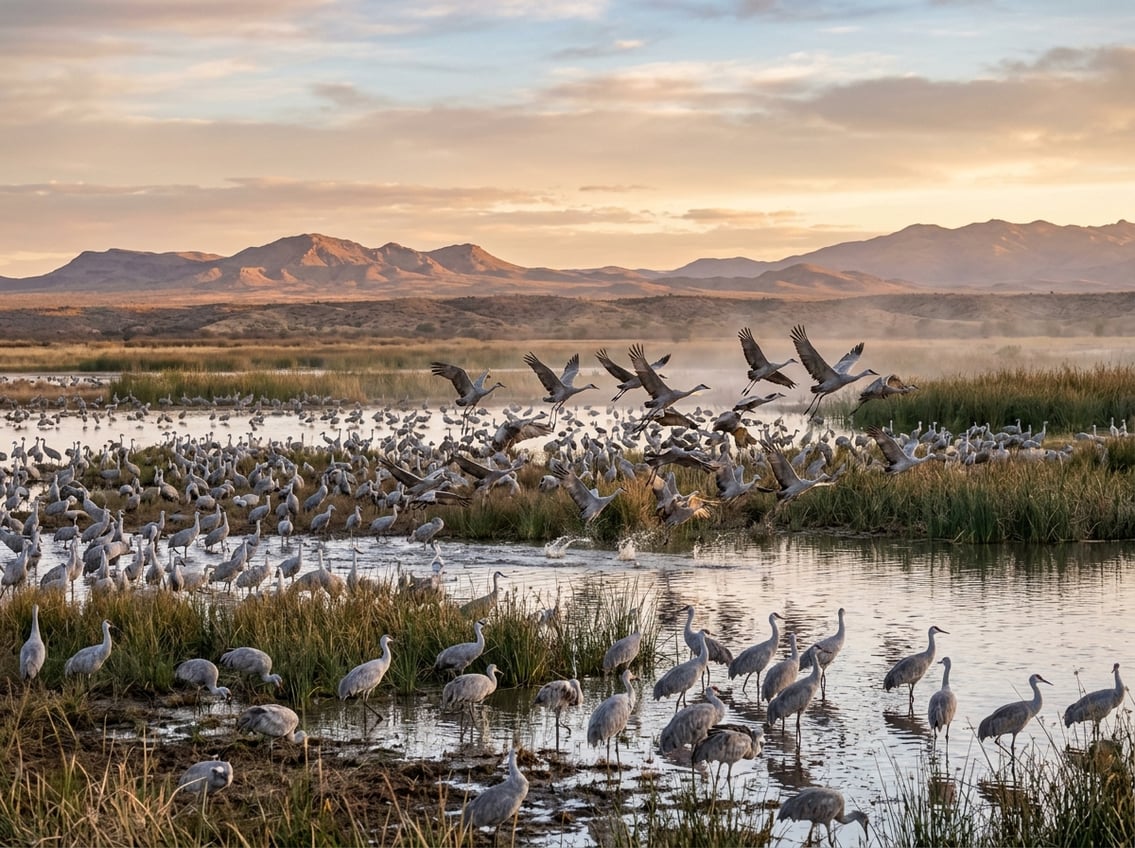
The U.S. Fish and Wildlife Service established this 57,331-acre sanctuary in 1939 to protect wintering waterfowl along the Rio Grande.
According to the refuge's wildlife watching guide, bird numbers peak between early November and late January. Flocks sleep in open water for safety, then lift off en masse at first light to feed in local grain fields.
An auto tour loop lets you watch northern harriers, bald eagles, and wintering ducks across managed ponds.
Bosque del Apache National Wildlife Refuge also provides vital sanctuary during spring and autumn, when shorebirds, warblers, and hummingbirds stop to rest.
3 Absolute Highlights:
- Witnessing the dawn blast-off of thousands of snow geese and sandhill cranes
- Driving the auto tour loop to watch hunting raptors and mixed waterfowl flocks
- Scanning drying wetland basins for migrating shorebirds in spring
Where to Stay near Bosque del Apache
Socorro, New Mexico lies about 20 miles north and serves as the primary base for refuge visitors.
Hotels like the Best Western Socorro or Holiday Inn Express put you a short drive from the gates. Compare options on Booking.com or Expedia, especially during the autumn crane festival.
Point Reyes, California: Pacific Coast Bird Diversity
Point Reyes National Seashore boasts exceptional avian diversity on the West Coast. Observers have recorded nearly 490 bird species across its 70,000 acres, according to the National Park Service.
The peninsula juts 10 miles into the Pacific Ocean. This acts as a natural trap for migrants traveling the Pacific Flyway from Alaska and Oregon down into California.
Birds funnel down from the Pacific Northwest, including coastal migrants moving past Olympic National Park, while rare vagrants arrive from across the continent.
Much like the salt marshes and rocky headlands found in Oregon, the varied terrain at Point Reyes gathers diverse waterfowl, shorebirds, and raptors in one protected sanctuary.
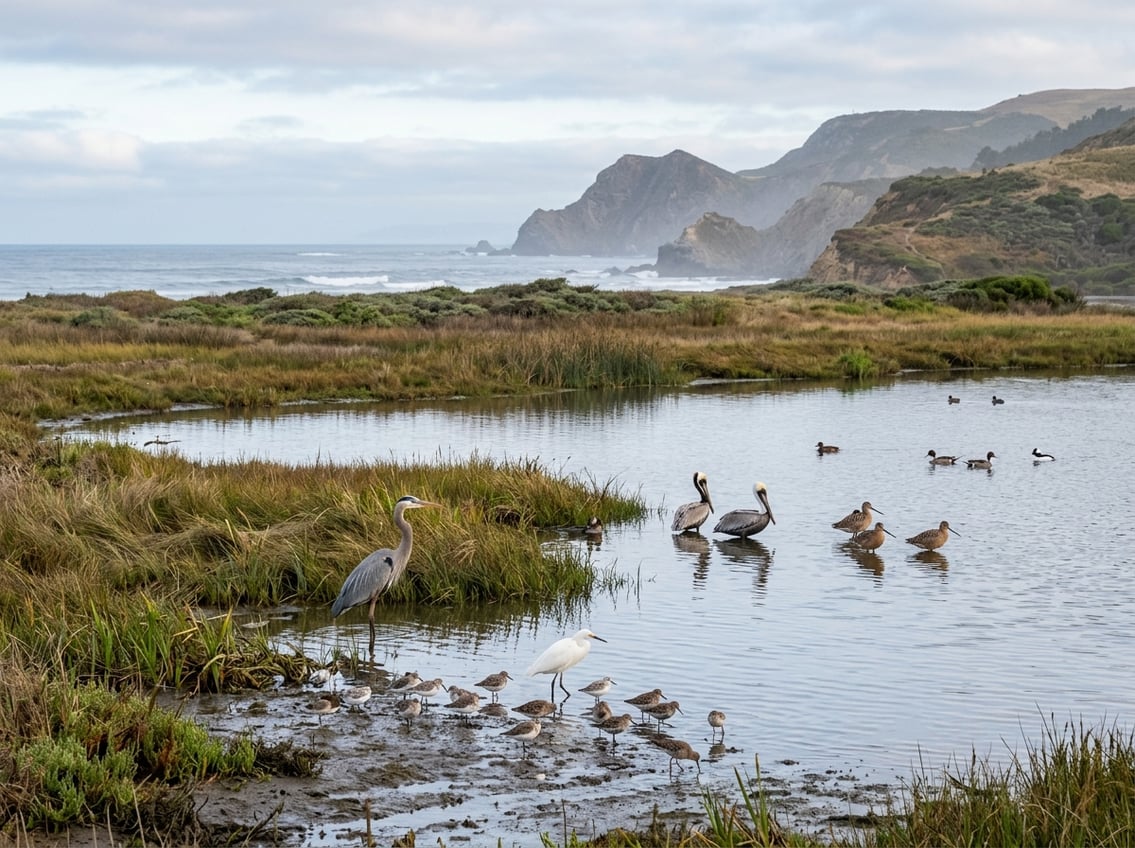
Each corner of the park harbors distinct bird communities. The National Park Service's wildlife viewing page highlights Abbotts Lagoon for shorebirds, wintering waterfowl, and hunting peregrine falcons.
Drakes Estero shelters egrets and resting brant geese, while the restored Giacomini Wetlands host dabbling ducks and elusive California black rails.
Because ocean breezes and distinct microclimates shape the peninsula, Point Reyes National Seashore supports both pelagic seabirds and deep-forest songbirds.
Out at the lighthouse, ocean cliffs provide prime views of nesting common murres, Brandt's cormorants, and passing seabirds.
3 Absolute Highlights:
- Hiking to Abbotts Lagoon in autumn for shorebirds and raptors
- Observing breeding seabird colonies from the windswept lighthouse cliffs
- Exploring the Giacomini Wetlands for secretive rails and wintering waterfowl
Where to Stay near Point Reyes
Olema House sits right beside the park boundary along Highway 1, offering fast access to trailheads.
Check Booking.com or Expedia to explore inns, cottages, and cabins across coastal West Marin.
Big Bend National Park: Desert and Mountain Birds
Big Bend National Park rewards adventurous birders with more than 450 recorded species, according to the National Park Service. Because water is scarce in the Chihuahuan Desert, roughly 75% of park sightings occur in river and oasis habitats.
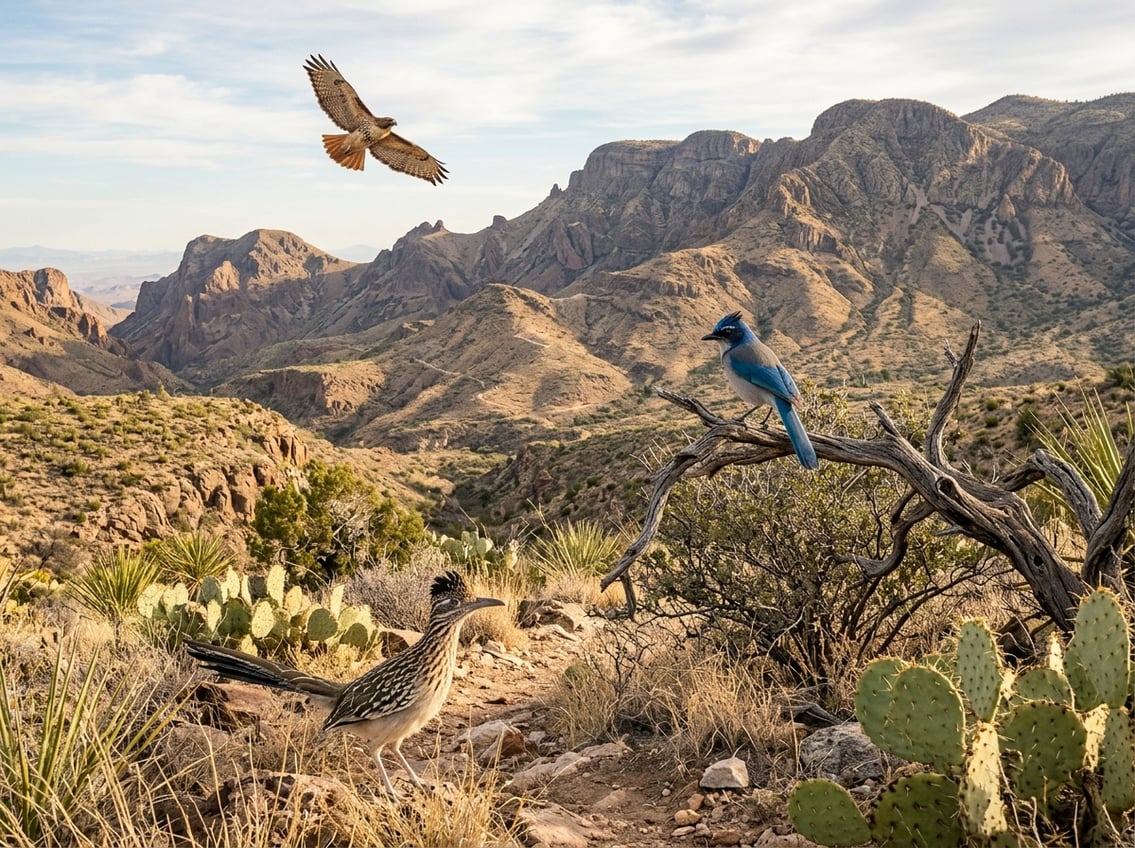
Rio Grande Village anchors the park's lowland birding with over 300 species. Its nature trail, cottonwood groves, and wetlands attract vermilion flycatchers, yellow-breasted chats, and painted buntings.
Higher up, the Chisos Mountains support oak-pine woodlands where you can find species absent elsewhere in the park. Hikers tackle the steep trail to Boot Canyon each spring to glimpse the Colima warbler, which nests nowhere else in the United States.
The National Park Service's seasonal guide marks late April through early May as the top window. Look for Lucifer hummingbirds sipping nectar in desert washes like Blue Creek.
Note: The National Park Service plans major construction in the Chisos Basin starting May 1, 2026, closing the lodge and nearby trails for about two years.
3 Absolute Highlights:
- Birding the lush cottonwood groves and wetlands at Rio Grande Village
- Trekking into Boot Canyon to find the exclusive Colima warbler
- Spotting Lucifer hummingbirds among blooming desert plants in Blue Creek Canyon
Where to Stay near Big Bend
Terlingua and Study Butte sit just outside the park's western entrance and offer dining, motels, and cabins.
Compare local options on Booking.com or Expedia, and check the park's Chisos Basin access updates before traveling.
Denali National Park: Alaska's Tundra Birds
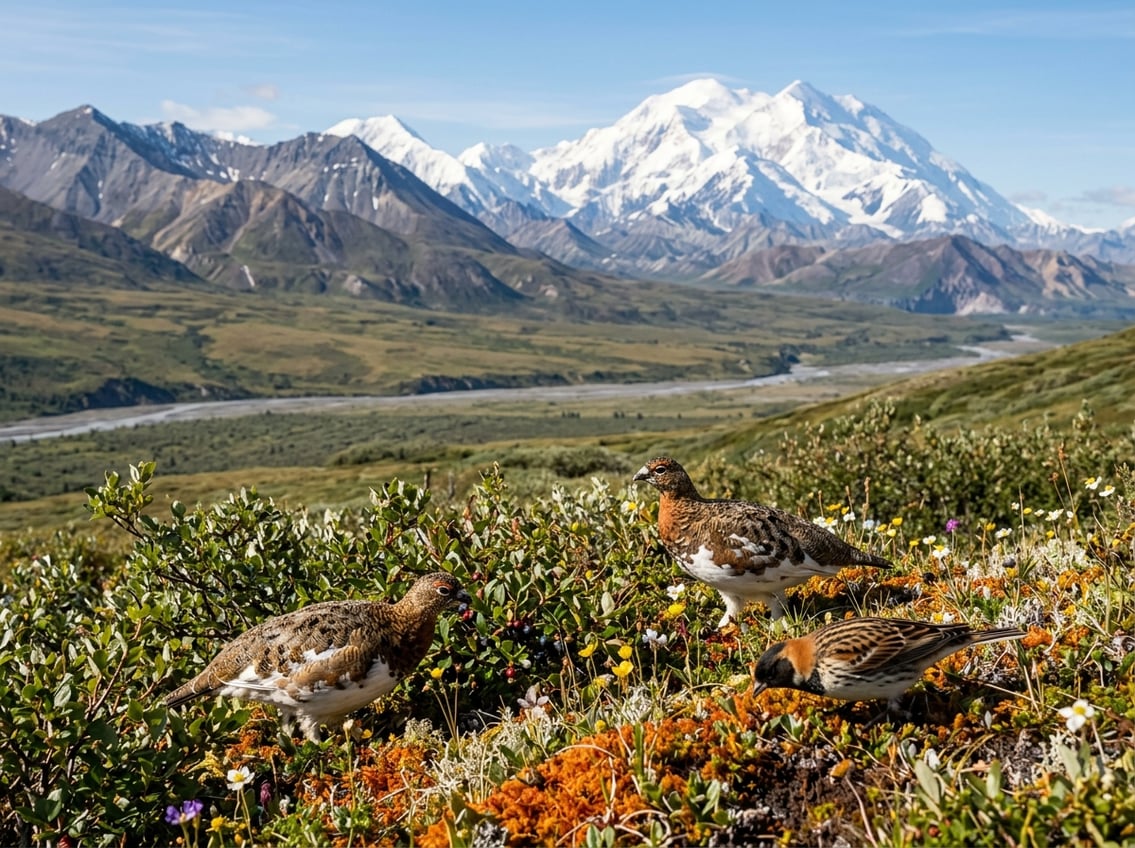
Denali National Park gives birders a rare chance to see subarctic and tundra breeders. The summer season is brief but intense, compressing courtship and nesting into a few short months.
While Rocky Mountain gems across Colorado and Wyoming's Yellowstone National Park harbor trumpeter swans and raptors, Denali showcases raw subarctic wilderness.
Open high country throughout Wyoming provides classic Western birding, but Denali offers subarctic species found nowhere else along the standard road system.
The sole park road spans diverse ecosystems as it climbs into the interior.
Boreal spruce near the entrance yields to open alpine tundra, where willow and rock ptarmigan roam among stunted shrubs.
Long-tailed jaegers patrol open flats, while golden eagles and gyrfalcons hunt along mountain ridges. Summer also brings Arctic-breeding shorebirds, including wandering tattlers nesting beside gravel streams.
Before traveling, check the park website for current road conditions and shuttle transit schedules, which vary each season.
3 Absolute Highlights:
- Watching willow and rock ptarmigan feed quietly on open alpine tundra
- Spotting gyrfalcons and golden eagles riding mountain updrafts
- Finding rare breeding shorebirds along glacial gravel riverbeds
Where to Stay near Denali
The canyon area along the Parks Highway, just outside the entrance, holds the widest selection of seasonal lodges and cabins.
Search Booking.com or Expedia well in advance, as summer rooms in Alaska book out months early.
Hawai’i Volcanoes National Park: Native Hawaiian Birds
Hawai’i Volcanoes National Park protects precious remnants of native rainforest on the Big Island, spanning the slopes of Kilauea and Mauna Loa. Mature ʻōhiʻa and koa woodlands provide vital shelter for endemic Hawaiian honeycreepers.
For birders visiting Hawaii, the park preserves rare endemic species found nowhere else on Earth.
Much like the high peaks of Maui, native forest birds here live only in high-elevation pockets, where cooler temperatures keep mosquito-borne avian malaria at bay.
Higher slopes along Mauna Loa offer your best chance to spot bright red ʻIʻiwi, crimson ʻApapane, and yellow-green Hawaiʻi ʻAmakihi. You may also encounter the endangered Nēnē, Hawaii's native goose, grazing along open volcanic meadows.
Start your search at dawn before mountain winds pick up and cloud cover moves into the canopy. Always check park alerts before hiking, as volcanic activity and weather can cause sudden trail closures.
3 Absolute Highlights:
- Searching high-elevation ʻōhiʻa canopies for the curved bill of the vibrant ʻIʻiwi
- Observing Nēnē family groups grazing near open grasslands and lava margins
- Listening to dawn chorus melodies from ʻApapane across rainforest trails
Where to Stay near Hawaiʻi Volcanoes
Volcano Village sits right at the park boundary, putting you within minutes of early morning trailheads.
Compare local lodges, bed-and-breakfasts, or hotels in nearby Hilo using Booking.com or Expedia.
Choose Your Hotspot by Season and Bird
Timing matters far more than simply picking a famous destination. A world-class hotspot can feel quiet if you visit during the off-season.
Whether you are trekking through the temperate rain forests of Oregon or scanning the Atlantic coastline, matching your trip dates to regional peak movements is essential.
Head to Magee Marsh Wildlife Area or High Island in spring for spectacular songbird fallouts. Visit Cape May, New Jersey in autumn for mass raptor flights, and head south to Bosque del Apache National Wildlife Refuge or the Everglades for winter wetland aggregations.
Other national parks reward travelers during different seasons. Great Smoky Mountains National Park offers lush nesting grounds for summer warblers, with varied mountain elevations supporting dozens of breeding species.
Birders exploring Great Smoky Mountains National Park can search for high-elevation specialists like black-throated blue warblers and Canada warblers along misty ridge trails.
Along the Atlantic coast, Acadia National Park near Bar Harbor, Maine provides dramatic granite cliffs and maritime spruce forests for seabirds and boreal finches.
Visiting coastal Maine during late spring or early autumn also gives you prime vantage points for pelagic boat tours and coastal raptor viewing.
Pack a dependable pair of 8x42 binoculars and a field guide targeted directly to your destination. Regional guides help you quickly sort through tricky plumages, whether identifying South Texas orioles or Alaskan shorebirds.
Keep your travel plans flexible whenever possible. Spring fallouts and autumn hawk flights depend heavily on shifting winds and storm fronts, rewarding birders who react to the weather.
Frequently Asked Questions
What is the best time of year for bird-watching in the United States?
Spring (April through May) and autumn (September through October) produce the largest bird numbers due to active migration. Winter also offers incredible spectacles, with thousands of waterfowl and cranes packing southern wetlands and desert refuges.
Which hotspot works best for beginner birders?
Everglades National Park and Magee Marsh are both ideal for beginners. Their flat, accessible boardwalks let you watch large wading birds and colorful songbirds up close without needing expensive spotting scopes.
Coastal spots like Acadia National Park also provide approachable viewing, thanks to well-marked carriage roads and ocean overlooks.
How does weather impact bird migration?
Northerly winds and cold fronts push massive raptor flights south in autumn. In spring, rain and headwinds over large water bodies force tired songbirds down into the first available coastal trees.
What essential gear should I bring on a birding trip?
Bring quality 8x42 binoculars, broken-in walking shoes, weather-appropriate layers, and a regional birding field guide or smartphone app. A spotting scope also helps for viewing distant shorebirds, seabirds, and waterfowl.
Comments